


بسم الله الرحمن الرحيم
The Attainment of Goals from the Book of the System of Islam
Halaqah 23
Fate (Al-QaDaa)
https://hizb-uttahrir.info/ar/index.php/articles/38061.html
(Translated)
All Praise is due to Allah, the Possessor of Grace and Favor, the One who cannot be wronged, and the One whose honor is beyond challenge. Peace and blessings be upon our master Muhammad, the best of mankind, the Seal of the great Messengers (as), and upon his family (ra), Companions (ra), and noble followers who implemented the system of Islam and adhered to its rulings with utmost commitment. O Allah, make us among them, gather us in their company, and keep us steadfast until we meet You on the Day of Resurrection when feet will slip in the time of turmoil.
O believers,
Asalaamu alaykum wa Rahmatullahi wa Barakatuh. To proceed: We continue with you the series of episodes from our book, “Attaining the Goals from the System of Islam.” And we are now at episode 23, titled, “Predestined Fate (Al-QaDaa)”. In it, we will reflect on what appears on page sixteen of the book “The System of Islam” by the alim and political thinker Shaykh Taqi al-Din al-Nabhani.
He says, may Allah (swt) have mercy on him, “Any individual who studies the actions of man accurately will observe that man lives within two spheres: one of them he dominates, which is the sphere that falls within the domain of his doings. His actions occur, within this sphere according to his free will. The other sphere dominates him and it is the sphere that embraces the human being himself and within it the actions, which he has no free will over, occur; whether they occur from him or on him.
In regards to the actions that fall within the sphere that dominates man, man has nothing to do with them or in their existence. They are divided into two sections: A section which is entailed by the existential order (Nitham Al-Wujood), and a section which includes those actions which are beyond the control of man and which he cannot avert, but which are not entailed by the existential order. As far as the actions, which are entailed by the existential order, man is in complete submission to them. Therefore, he is forced to proceed in accordance with them because he proceeds with the universe and life subject to a particular order that does not change. Subsequently, man’s actions in this sphere occur without his will and he is compelled and has no choice. Man came to this life without his will and he shall leave it without his will. He cannot fly in the air with his body alone, walk on water in his natural state, nor create the colour of his eyes. Man did not produce the shape of his head, and nor the size of his body. Indeed, it was Allah (swt) Who created all of this without the created servant having any say in that or relation. This is because Allah (swt) created the existential order, made it the regulator of the existence, and made the existence proceed in accordance to it, without being able to function differently.
As for the actions, which are beyond man’s control, which he is unable to avoid and they are not within the existential order, they are the actions which occur from the human being or upon him unwillingly, without him ever being able to avoid them. Examples of such actions are, if someone on a wall accidentally falls on a person and thus kills that person; or if someone shoots at a bird and the shot hits a person he was not aware of and kills him; or if a car goes off the road or a train derails, or a plane crashes. All of these are due to an unexpected failure without any possibility to avoid the accident, thus causing the death of the passengers. All of these examples of actions and the like which occurred from man or fell on him, are not within the existential order, yet they occurred from man or on him without his will and it was beyond his ability to control them. All of these actions, which occur within the sphere that dominates man, are termed QaDaa (fate), because Allah (swt) alone is the one who has predetermined them. Therefore, man is not accounted over these actions, regardless of there being benefit or harm, liking or disliking, for the human being i.e. regardless of the good (khair) or evil (shar) in them, according to human interpretation. Allah Alone knows the good (khair) and evil (shar) in these actions, because man has no influence over them, he does not know about them or the manner in which they came to be, and he is absolutely unable to avert them or beget them. The human being thus must believe in this QaDaa and that this QaDaa is from Allah (swt).” END QUOTE.
And we say, hoping for Allah’s Forgiveness, Mercy, Pleasure, and Paradise: May Allah (swt) reward Shaykh Taqi al-Din al-Nabhani with the best of rewards on behalf of Islam and the Muslims, and may He light up for him palaces in the highest level of Paradise, just as he enlightened our minds with his illuminated thinking, and brought peace to our hearts through exploring issues that we are in desperate need of.
We are now reading one of his books, namely, “The System of Islam,” which is part of a precious series of books worthy of being written in gold. In them, our Shaykh (ra) poured the essence, the summary, indeed the very cream of his thoughts, which he selected and distilled from tens of thousands of books he had read and examined, in which he found the worthless and the valuable, the sound and the corrupt, the correct and the mistaken, the truth and the falsehood. He kept selecting for us the finest of thoughts just as we select the finest of fruits, until he presented this thought to us, pure, clear, crystallized, and as clear as the sun at midday. There is no confusion or ambiguity in it. His books truly deserve to be read, studied, understood, and spread across the world. Indeed, through our study and deep research into the topic of Fate and Predetermination (Al-QaDaa wal Qadar), it has become clear to us that precision in research requires knowledge of the correct foundation upon which the discussion must be built. We also found that the scholars who discussed the issue of Fate and Predetermination mentioned four matters, considering each of them as a foundation for its discussion, but it has become clear to us that none of them are suitable for this topic, and that the correct foundation is reward and punishment.
Any individual who studies the actions of man accurately will observe that man lives within two spheres:
The first sphere is which the human dominates.
The human chooses.
The second sphere dominates the human.
The human is compelled through Fate.
It is the sphere that falls within the domain of his doings. His actions occur within this sphere according to his free will. For example, he leaves his house by his own choice and will, and he can either go to the mosque to be obedient to Allah (swt), or to places of amusement and immorality to commit a sin, may Allah (swt) forbid. In this circle, he is free to choose and is not compelled.
It is the sphere in which the human falls under its scope, and in it, he is compelled and not free. Within this sphere are actions in which he has no involvement, whether they happen by him or to him. These actions are not connected to him, and he has no control over their existence. They are divided into two sections:
1. The first section which is entailed by the existential order (Nitham Al-Wujood), the human moves according to it compulsorily and is subject to it because he moves with the universe and life according to a specific, unchanging system. For example, he cannot walk naturally on water.
2. The second section which he is unable to avoid and they are not within the existential order, such as if someone shoots at a bird and the shot hits a person he was not aware of and kills him.
The actions that occur in this circle, which the human performs voluntarily and by his own will, are those for which he is held accountable with reward or punishment. If he obeys Allah (swt), he enters Paradise, and if he disobeys Allah (swt), he enters Hellfire, and your Lord is not unjust to His servants.
The actions that occur in this sphere are called Qadaa (Fate), and the servant is not held accountable for them no matter if they bring benefit or harm, good or evil. A person must believe that this Qadaa is from Allah (swt).
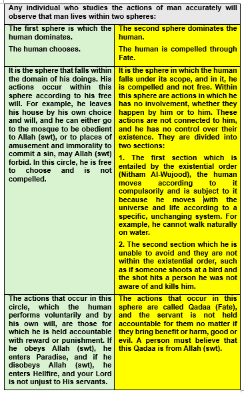
Shaykh Taqi al-Din showed remarkable creativity in conveying the thought to our minds when he portrayed the human being through the perspective of his actions, as living within two spheres: The first sphere is one which he dominates, and the second is one which dominates him. When he began to elaborate on these two spheres, he said that the first sphere is the one that falls within the scope of his actions, and within it occur the actions he performs by his own choice. He is responsible for these actions and accountable for them. He said about the second sphere that it is the sphere in which he falls under its domain, and within this sphere are the actions over which he has no control, whether they happen by him or to him. He mentioned that these actions are of two kinds:
The first type: Actions required by the law of the world, to which a person submits and follows compulsorily. He moves along with the universe and life according to a specific, unchanging system. The human’s actions within this sphere occur without his will. He is driven within it, not acting out of free choice. He provides examples of such actions, including that a person comes into this world without his will, and will leave it without his will, and he cannot simply fly through the air with his body.
The second type: Actions that are beyond human capability, which he cannot prevent, and are not required by the laws of the world. These are actions that happen to, or because of, him compulsorily, and he has no power whatsoever to stop them. He gives examples of these actions, such as a person falling from the top of a wall onto another person and killing him, or if a person shoots a bird and it hits a person he did not know, killing him.
After the Shaykh (ra) classified these actions according to whether a person performs them by compulsion or by choice, and whether they are required by the laws of the world or not, he then moved on to classify actions in terms of reward and punishment. He mentioned that the actions a servant performs by his own choice are those for which he will be held accountable, while the actions over which he has no control, which happen to him or because of him against his will, are not to be held accountable no matter if they involve benefit or harm, loved or disliked by the person, that is, regardless of the good or evil they may contain as interpreted by humans. Indeed, Allah (swt) alone knows the evil and good in these actions, because the human has no influence over them, nor knowledge of them, nor of the manner of their creation, and the human does not have the power to prevent or bring them about at all.
At the conclusion of the topic, the Shaykh (ra) mentions the connection between the discussion of Fate and the Islamic aqeedah, saying, “All of these examples of actions and the like which occurred from man or fell on him, are not within the existential order, yet they occurred from man or on him without his will and it was beyond his ability to control them. All of these actions, which occur within the sphere that dominates man, are termed QaDaa (fate), because Allah (swt) alone is the one who has predetermined them ... The human being thus must believe in this QaDaa and that this QaDaa is from Allah (swt).”
O believers:
We will conclude this session here. Our next meeting is scheduled for the upcoming session, insha Allah. Until then, we leave you in the care, protection, and security of Allah (swt). We ask the Almighty to honor us with Islam, to elevate Islam through us, to grant us His victory, and to make our eyes rejoice at the establishment of the Second Righteous Caliphate on the Method of Prophethood in the near future. May He make us among its soldiers, witnesses, and martyrs. Indeed, He is the Protector and Capable of it. We thank you for your attentive listening.
Wasalamu Alaykum wa Rahmatullah.