


بسم الله الرحمن الرحيم
The First Section of the Research: Authentic Prophetic Texts
Concerning the issue of the end of one month and the beginning of the next, the number of days in a month, and the non-reliance on calculation, compiled in a comprehensive format while preserving the original wording of the narrations from the two Sahihs, Bukhari and Muslim, then the four Sunan and the authentic Musnads, with disparate narrations of the same hadith combined into a single text within brackets.
The first hadith: «صوموا لرؤيته وأفطروا لرؤيته» “Fast when you see it (the new moon) and break your fast when you see it.” The original narration: Sahih al-Bukhari,
«صوموا لرؤيته، وأفطروا لرؤيته، فإن غُمّ عليكم فأكملوا عدة شعبان ثلاثين يوماً»
“Fast when you see it, and break your fast when you see it. If it is obscured from you, then complete the count of Sha’ban as thirty days” (narrated by al-Bukhari (Hadith No. 1909), Muslim (1081), Abu Dawud (2320), al-Tirmidhi (684), al-Nasa’i (2097), and Ibn Majah (1654)). Other narrations,
«فإن غمّ عليكم فاقْدُروا له»
“If it is obscured from you, then estimate it” (narrated by Muslim),
«فإن أغمي عليكم فاقدروا له ثلاثين يوماً»
“If it is obscured from you, then estimate it as thirty days” (narrated by Abu Dawud), «فإن غُبّي عليكم فأكملوا العدة ثلاثين» “If it is obscured from you, then complete the count to thirty” (narrated by An-Nasa’i). Note: «فاقدروا له» “Estimate it” has been interpreted in several ways, including: completing the count to thirty (which is the correct and accepted view according to the majority), or calculating the lunar phases (a view held by the Hanafis and some Zahiris, but considered weak by the majority). The meaning conveyed by the authentic narrations of the phrase «فاقدروا له» “Estimate it” is completing the count to thirty, not shifting the basis of evidence to calculation. This is because there are explicit narrations stating, «فأكملوا العدة/عدة شعبان ثلاثين» “Complete the count/the count of Sha’ban to thirty.” Therefore, the claim that calculation is an independent method for determining the month does not align with the apparent meaning of these explanatory narrations. Even if there are a few interpretations that apply the phrase to calculation, they are limited and varied, and do not stand up to the practical Prophetic interpretation held by a wide majority of ulema.
The second hadith: Acting upon the sighting of the Hilal crescent moon, not upon any other means (signs). The hadith,
«لا تصوموا حتى تروه، ولا تفطروا حتى تروه»
“Do not fast until you see it, and do not break your fast until you see it” (narrated by al-Bukhari (1906) and Muslim (1080)). Benefit: This is a definitive text stating that what matters is the sighting of the crescent moon, not clouds, calculations, or estimations.
The third hadith: The month is either 29 or 30 days. The original narration: Sahih al-Bukhari:
«إنّا أمةٌ أمّيّة، لا نكتب ولا نحسب، الشهر هكذا وهكذا وهكذا - يعني: ثلاثين، ثم قال: - وهكذا وهكذا وهكذا- يعني: تسعًا وعشرين»
“We are an unlettered Ummah; we neither write nor calculate. The month is like this, like this, like this”—meaning thirty days. Then he said. وهكذا وهكذا وهكذا “like this, like this, like this”—meaning twenty-nine days (narrated by al-Bukhari (1913), Muslim (1080), Abu Dawud (2319), al-Nasa’i (2110), and al-Tirmidhi (685)). Other narrations:
«إن الشهر تسع وعشرون، فلا تصوموا حتى تروه، ولا تفطروا حتى تروه»
“The month is twenty-nine days, so do not fast until you see it, and do not break your fast until you see it” (narrated by Muslim).
«فإن غُم عليكم فاقدروا له»
“If it is obscured from you, then estimate it” (narrated by al-Tirmidhi).
The fourth hadith: Fasting on the day the people fast: Original narration: Sunan al-Tirmidhi:
«الصوم يوم يصوم الناس، والفطر يوم يفطر الناس، والأضحى يوم يضحي الناس»
“Fasting is on the day the people fast, breaking the fast is on the day the people break their fast, and Eid al-Adha is on the day the people sacrifice” (narrated by al-Tirmidhi (697), who said: It is a Hasan Gharib hadith. Also narrated by Abu Dawud (2324) with some similar meaning, and by al-Daraqutni (2/162). It was authenticated by Ibn Khuzaymah (1916) and Ibn Hibban (871)). Other narrations,
«والفطر يوم يفطر الإمام»
“Breaking the fast is on the day the imam breaks his fast” (narrated by al-Daraqutni).
«الصوم يوم تصومون، والفطر يوم تفطرون، والأضحى يوم تضحون»
“Fasting is on the day you fast, breaking the fast is on the day you break your fast, and Eid al-Adha is on the day you sacrifice” (narrated by Ibn Khuzaymah).
The fifth hadith: Do not precede Ramadan by fasting a day or two: Original narration: Sahih al-Bukhari,
«لا تقدموا رمضان بصوم يوم ولا يومين، إلا رجل كان يصوم صوماً فليصمه»
“Do not precede Ramadan by fasting a day or two, except for a man who has a habit of fasting; let him fast” (narrated by al-Bukhari (1914), Muslim (1082), Abu Dawud (2335), and al-Nasa’i (2188)). Other narrations, «إلا أن يكون صوماً يصومه أحدكم فليصمه» “Unless it is a fast that one of you regularly observes, then let him observe it” (narrated by Muslim).
«إلا أن يوافق صوماً كان يصومه أحدكم»
“Unless it coincides with a fast that one of you regularly observes” (narrated by An-Nasa’i).
The sixth hadith: The Hilal crescent for Fasting and Breaking the Fast: Original narration: Sunan Abi Dawud,
«الهلال هلالُ صيام، والهلال هلال فطر، فلا تصوموا حتى تروه، ولا تفطروا حتى تروه»
“The Hilal crescent is the Hilal crescent of fasting, and the Hilal crescent is the Hilal crescent of breaking the fast, so do not fast until you see it, and do not break the fast until you see it” (narrated by Abu Dawud (2321) and Ibn Majah (1653)). Other narrations, «فإن غُمّ عليكم فعدّوا ثلاثين يوماً» “If it is obscured from you, then count thirty days” (narrated by Ibn Majah).
The seventh hadith: «إذا رأيتموه فصوموا، وإذا رأيتموه فأفطروا» “If you see it, then fast, and if you see it, then break the fast” Original narration: Sahih Muslim:
«إذا رأيتموه فصوموا، وإذا رأيتموه فأفطروا، فإن غُمّ عليكم فاقدروا له ثلاثين»
“If you see it, then fast, and if you see it, then break the fast. If it is obscured from you, then estimate thirty days for it.” Narrated by Muslim (1081), Abu Dawud (2320), and At-Tirmidhi (684).
The eighth hadith: «فإن شهد شاهدان فصوموا وأفطروا» “If two witnesses testify, then fast and break your fast” (narrated by An-Nasa’i (2117), Abu Dawud (2340), and Ibn Hibban (876), who authenticated it).
The hadith of Ibn Umar (ra), «تراءى الناس الهلال، فأخبرت النبي ﷺ أني رأيته، فصام وأمر الناس بصيامه» “The people were looking for the new moon, and I informed the Prophet (saw) that I had seen it, so he fasted and commanded the people to fast” (narrated by Abu Dawud (2342) and Ad-Daraqutni (2/157), and authenticated by Ibn Khuzaymah (1905)). A point of interest: This indicates that the testimony of one just witness is sufficient for sighting the new moon of Ramadan, while two witnesses are required for sighting the new moon of Shawwal according to some ulema.
The ninth hadith: Fasting with the intention of fasting during the day if the news reaches the Prophet (saw),
«جاء أعرابي إلى النبي ﷺ فقال: إني رأيت الهلال، فقال: أتشهد أن لا إله إلا الله؟ قال: نعم. قال: فأذّن في الناس أن يصوموا»
“A Bedouin came to the Prophet (saw) and said: ‘I have seen the new moon.’ He said: ‘Do you testify that there is no god but Allah?’” He said: Yes. He said: Then announce to the people that they should fast” (narrated by Abu Dawud (2340), At-Tirmidhi (691), and An-Nasa’i (2115)). In another narration,
«جاء أعرابي إلى النبي ﷺ ، فقال: إني رأيت الهلال، فقال: أتشهد أن لا إله إلا الله؟ قال: نعم، قال: أتشهد أن محمدًا رسول الله؟ قال: نعم، قال: يا بلال، أذن في الناس أن يصوموا غدًا»
“A Bedouin came to the Prophet (peace and blessings be upon him) and said: I have seen the crescent moon. He said: Do you bear witness that there is no god but Allah? He said: Yes. He said: Do you bear witness that Muhammad is the Messenger of Allah? He said: Yes. He said: O Bilal, announce to the people that they should fast tomorrow” (narrated by Abu Dawud (2340), At-Tirmidhi (691), An-Nasa’i (2116), Ibn Khuzaymah (1907), Ibn Hibban (870), and Ad-Daraqutni (2/161)). Benefit: This is evidence for beginning the fast after dawn if the start of Ramadan is confirmed afterward. This has been permitted by the Malikis, Hanbalis, and some Hanafis. Some ulema have cited other contexts to support the permissibility of fasting with the intention of beginning the fast during the day if a person is unaware that Ramadan has begun. Among them are: the Malikis, who said that fasting Ramadan with the intention of beginning the fast during the day is valid if the new moon is confirmed after dawn; Ahmad ibn Hanbal, in one narration, who permitted fasting during the day if the news reached him but he had not yet eaten; and al-Shafi'i, in a less preponderant opinion, who permitted the intention to begin the fast during the day in Ramadan due to the excuse of ignorance.
The tenth hadith: On the authority of Abu Hurairah (ra),
«أن رجلًا جاء إلى النبي ﷺ فأخبره أنه رأى الهلال، فأمر رسول الله ﷺ الناس بالإفطار، فأفطروا، ثم خرج فصلى بهم المغرب»
“A man came to the Prophet (saw) and informed him that he had seen the new moon. So the Messenger of Allah (saw) ordered the people to break their fast, and they did so. Then he went out and led them in the Maghrib Salah” (narrated by al-Nasa'i (2106) and al-Daraqutni). This indicates that the news came during the day (before Maghrib). The sighting was on the night of Eid (the crescent of Shawwal). The Prophet (saw) ordered the people to break their fast, even though they were fasting that day. It was not a condition that the witness be from the same town. Nor was it a condition that the people be informed before dawn. Instead, even if the news reached them during the day, the ruling was the same. It changes immediately. This supports the view that the sighting of the new moon is a unified sighting if it is confirmed, and it indicates that Islamic law does not base the beginning of the month on calculations or narrow geographical boundaries, but rather on a correct sighting when it reaches Muslims at a time suitable for its implementation. Asma’ bint Abi Bakr (ra) said,
«أفطرنا على عهد النبي ﷺ يوم غيم، ثم طلعت الشمس»
“We broke our fast during the time of the Prophet (saw) on a cloudy day, then the sun appeared” (narrated by Al-Bukhari (1959)). This hadith does not indicate acting upon a report of a sighting, but it does indicate the ease with which the Shariah ruling of fasting on that day can be overturned, after an error in the calculation is confirmed. It also suggests that a ruling can be based on what becomes apparent later, not just what was known at dawn.
The Second Section of the Research: Unity and Differences in Moon Sighting Methods for Establishing the Hilal Crescent:
The issue of sighting the Hilal crescent and determining the beginnings of lunar months is one that combines Islamic and astronomical sciences, where Shariah texts intertwine with modern scientific data. Questions have been raised about the possibility of unifying moon sighting methods across Muslim countries, especially given their varying geographical locations and differing visibility conditions.
Terms related to the research with simplified explanations:
Simplified definitions and clear explanations suitable for researchers, students of Islamic knowledge, and those interested in the fiqh (jurisprudence) of the crescent:
1- Conjunction: Definition: It is the moment when the moon, sun, and earth are on a single line, aligned upon one axis, exactly, before sunset, such that the moon is between the earth and the sun, and we do not see any illuminated part of it. (Note: If the earth, sun, and moon were on a single line, a solar eclipse would occur, which is a special case of conjunction). Simplified explanation: Imagine the sun, moon, and Earth aligned in a straight line… At this moment, the new Hilal crescent moon is born, but it is not yet visible because it is directly in the direction of the sun. This is the astronomical moment of the moon's birth, calculated with an accuracy of down to the second, and is sometimes called the geocentric conjunction.
2- Crescent Regarding Visibility and Appearance: Definition: This is the moment when the Hilal crescent moon can be seen with the naked eye or a telescope after conjunction. It occurs when the moon moves slightly away from the sun in the sky. In other words, it is the moon's separation from the sun after conjunction. Simplified explanation: Conjunction means the moon has been born, while “Hilal crescent” means the moon has begun to be visible. This appearance may be delayed for several hours after conjunction. We see the moon when part of it is illuminated and it moves slightly away from the bright sunlight.
3- Elongation: Definition: This is the angle between the sun and the moon as seen from Earth. It is the angular separation between the Sun and the planet. Simplified explanation: The farther the moon is from the sun in the sky, the larger the angle between them, making it easier to see. If the angle is very small (less than 5 degrees), the Hilal crescent moon is difficult to see. Typically, the elongation needs to be more than 8 degrees to see the crescent moon with the naked eye.
4- Moon’s Altitude: Definition: This is how many degrees the moon is above the horizon at sunset. Simply put: If the moon is higher in the sky after sunset, it is easier to see. If it sets before the sun or is close to the horizon, it cannot be seen. Usually, the moon should be at least 5 degrees above the horizon at sunset.
5- Moon-Sunset Lag Time: Definition: This is the time it takes for the moon to set after the sun. Simply put: If the moon sets a sufficient time after the sun, it remains visible in the sky for a short period, making it possible to see. Ideally, the difference should be 45 minutes or more to see the crescent moon with the naked eye.
6- Illuminated Fraction: Definition: This is the percentage of the moon’s surface that is illuminated at the moment of sighting. Simply put: The Hilal crescent moon is the first illuminated part of the moon. If it is less than 1%, it is difficult to see. Visibility usually begins at 1-2% illumination.
7- Danjon Limit: Definition: This is the smallest elongation angle at which the Hilal crescent moon can be seen with the naked eye. Simplified explanation: It was once believed that the eye could not see the Hilal crescent moon if the angle was less than 7 degrees, but some recent studies suggest that 4.5 degrees is sometimes sufficient under excellent conditions.
8- Difference in Moonrise Times: Definition: This refers to the difference in visibility of the Hilal crescent moon between different countries or locations on Earth. Simplified explanation: Due to the Earth’s rotation and the varying locations of countries, the crescent moon may be visible in some areas but not in others on the same night.
9- Moon’s Birth Before or After Sunset: Definition: An important condition is that the new moon (i.e., the conjunction) must occur before sunset in a given location. Simplified explanation: If the new moon is born after sunset, it cannot be seen that night. However, if it is born before sunset, it may be visible if the other conditions are met.
First: What are the Astronomical Zones of Visibility (Visibility Curves) for Moon Sighting?
Astronomical definition of zones of visibility: In technical terms, zones of visibility are the locations where the Hilal crescent moon first appears after its birth (conjunction). Zones of visibility refer to the locations from which the Hilal crescent moon can be seen after sunset. These locations vary based on several astronomical factors, including: First: The moon’s position relative to the horizon: The moon’s altitude above the horizon at sunset affects the possibility of seeing it. Second: The elongation angle: This is the angular distance between the sun and the moon. The greater this angle, the greater the chances of seeing the crescent moon. Third: Atmospheric conditions: Clear atmospheric conditions and the absence of particulate matter play an important role in improving the chances of sighting the Hilal crescent moon.
The Difference in Hilal Crescent Sighting: What Do Astronomical Calendars Exactly Mean?
Modern astronomical maps show variations in the possibility of sighting the Hilal crescent moon across different regions. These regions are divided into three categories: First, regions where visibility is impossible: the moon sets before the sun or is very close to it. Second, regions where visibility is possible only with a telescope: due to the Hilal crescent's faint illumination or its proximity to the horizon. Third, regions where visibility is possible with the naked eye: this occurs when atmospheric conditions are suitable and the Hilal crescent is high enough above the horizon.
A practical example: The Hilal crescent moon of Shawwal 1446 AH: According to astronomical reports, the geocentric conjunction of the Hilal crescent moon of Shawwal 1446 AH occurred on Saturday, March 29, 2025. After sunset on that day, the Hilal crescent moon was not visible in most Arab and Muslim countries due to its proximity to the sun and the horizon. However, it was visible in some western regions of the world, leading to a difference in the start of Shawwal among Muslim countries.
There are eleven schools of astronomical calculations that determine the lunar phases. This means that astronomers are divided into eleven schools of thought, each with its own method of calculation and factors that differ from those considered by other schools. Consequently, their conclusions regarding the possibility or impossibility of sighting the crescent moon vary enormously, in different parts of the world!
Now is presented a detailed explanation, using precise scientific and jurisprudential language, clarifying the differences between definitive and probabilistic calculations, detailing the factors that influence the different schools of thought in estimating the possibility of sighting the Hilal crescent, within the lunar phases, providing examples and approximate values for each factor.
The lunar phases vary based on the moon’s position relative to the horizon and its angle of inclination from the sun.
Astronomically, there is what is known as the “line of unity of the visibility curves,” which divides the Earth into two hemispheres:
West of the line: visibility possible
East of the line: visibility impossible. However, this line changes monthly according to the lunar cycle, making its reliability flexible and not fixed.
Therefore, it is observed that the processes of conjunction and new Hilal crescent moon depend on the movement of the Earth and the Moon. In the eastern hemisphere, the conjunction or new Hilal crescent moon, or both, may be delayed because this depends on the date of the new Hilal crescent moon, the date of its conjunction with the Sun, and then its separation from the Sun (new Hilal crescent moon).
Second: Types of Astronomical Differences in Visibility
The moon may have already been born, so conjunction has occurred, but:
It may not yet be visible at sunset in a particular country.
The new Hilal crescent moon may appear after conjunction, but the moon may be below the horizon in some locations.
Or the elongation angle, the angular distance between the sun and the moon, may be small, making it invisible.
Or the moon may be present, but its light may be scattered, or the atmosphere may be polluted, making it invisible.
The conjunction or new Hilal crescent moon may occur after sunset in a particular country.
The new Hilal crescent moon may appear after conjunction, but the moon may set before the sun in some countries.
The new Hilal crescent moon may appear after conjunction, but the moon may be close to the sun relative to visibility, or close to the horizon, making it impossible to see in some countries. These and other factors can delay the sighting of the new Hilal crescent moon by a day or more in some countries.
Therefore, modern Hilal crescent visibility maps are divided into four zones, and sometimes five:
|
Color on maps |
Visibility Curve Type |
| Grey |
Impossible to see |
| Red |
Visible only with a telescope |
| Orange |
Visible with a telescope and atmospheric conditions |
| Green |
Visible with the naked eye |
| Blue |
Visible and guaranteed |
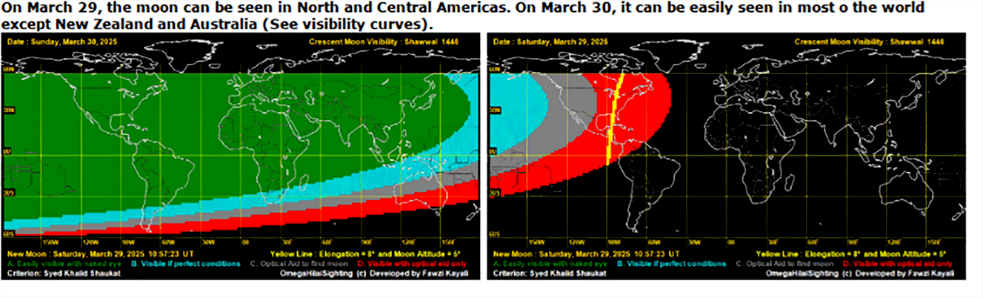
These areas you see on maps, grouped under a single color, are what are known as rising points!
Example: A map from the website moonsighting. The right side shows Saturday, March 29th, and the left side shows Sunday, March 30th, 2025. The green areas are easily visible to the naked eye, and so on.
Modern crescent visibility maps are divided into colored zones showing the visibility of the crescent moon across the globe. These colors indicate “visibility curves,” which are areas that share the same visibility of the Hilal crescent moon, regardless of political borders between countries. This means that geographically distant countries may fall within the same rising point zone, resulting in a similar visibility of the crescent moon.
Differences Among Astronomical Schools in Determining the Moon’s Visibility:
Astronomical schools differ in their criteria for determining the visibility of the Hilal crescent moon, leading to variations in the division of regions on maps:
Yallop School: Relies on criteria such as the moon's altitude above the horizon, the elongation angle, and the difference in sunset and moonset times. These criteria are used to determine the possibility of visibility with the naked eye or using a telescope.
Odeh School: Uses similar criteria, emphasizing actual observational data and updating the criteria based on field observations.
Saymon School (SAAO): Focuses on the elongation angle and altitude, while also considering the effects of atmospheric conditions on visibility.
These differences lead to variations in determining the moon’s visibility among astronomical schools, affecting the determination of the beginnings of lunar months in different countries.
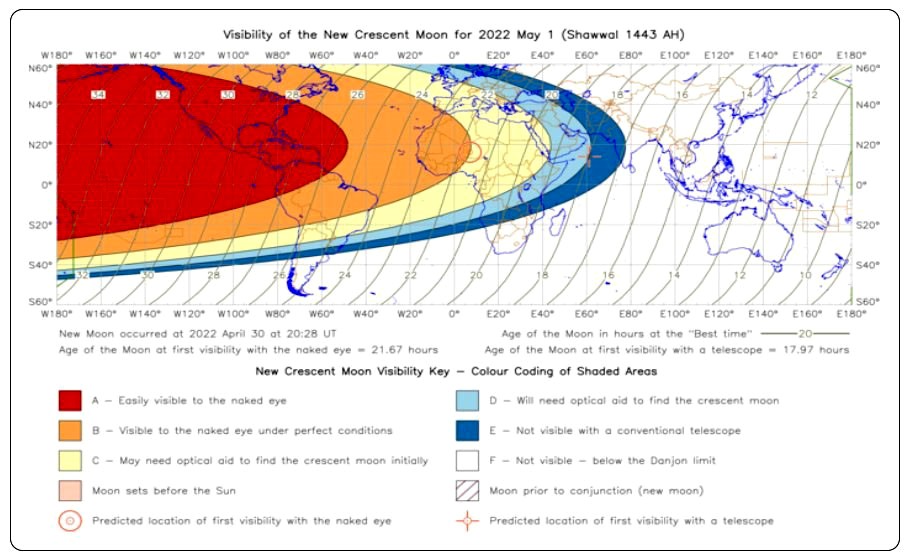
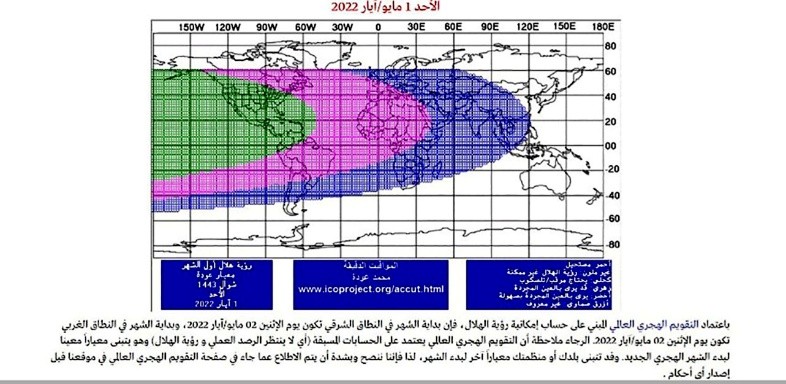
Conclusion: The moon’s visibility is not determined by political boundaries but rather by astronomical and geographical conditions that affect the possibility of sighting the Hilal crescent moon. Therefore, geographically distant countries may share the same moon's visibility, necessitating coordination and standardization in determining the beginnings of lunar months based on astronomical criteria and the Islamic Shariah sighting. For example, look at and compare the following two maps relating to May 1, 2022, the beginning of Shawwal 1443 AH, where you will find that a huge area such as all of North Africa requires a telescope to see, while in the second one the Hilal crescent may be seen with the naked eye in those areas, and in areas extending from the east of the earth to about the middle of India, estimates differed in the possibility of seeing it.
The difference between definite and probable calculations in sighting the Hilal crescent moon, and the most important factors involved in astronomical calculations:
| Is it definite? |
The extent to which it is dependable in Shariah |
What is it? | Type |
|
Yes (very accurate down to the second)
|
It can only be relied upon to deny sighting (if the moon has not been born, the Hilal crescent cannot be seen).
|
Calculating the birth of the moon (astronomical conjunction)
|
Definite calculations
|
|
No, because it depends on many variable factors.
|
It is not dependable in Shariah except as a guideline, because it is subject to many possibilities.
|
Calculating the possibility of seeing the crescent moon after its birth
|
Probable calculations
|
What Does “Visibility” Mean? And Why Is It Uncertain?
Visibility doesn't simply mean the presence of the Hilal crescent moon, but rather its visibility to the naked eye or a telescope, based on dozens of subtle factors, some of which cannot be determined mathematically. The most prominent of these factors are:
Hilal Crescent Moon Age (Since the Moment of Conjunction):
The age of the Hilal crescent moon alone is not a definitive criterion for visibility, as visibility depends on multiple geometric and observational factors, including elongation, altitude of the crescent, time between sunset and moonset, atmospheric clarity, and the observer's experience. Therefore, scientific authorities have stated that predicting visibility based solely on age is uncertain, and that in the early days, the Hilal crescent moon is close to the horizon and visible in intense twilight, and may be impossible to see even after the conjunction has occurred. Accordingly, the most scientifically sound approach is to consider age as a secondary indicator, and to use the criterion of absolute impossibility in cases where experts are certain, such as the moon being below the horizon, setting before the sun, or the conjunction occurring after sunset at that location.
The values used in reputable astronomical studies, these are reference figures, not definitive criteria; note that the age of the crescent moon is a secondary factor, and the more reliable criteria are the angular elongation, the moon's altitude, and the time between sunset and moonset, and that definitive proof of its visibility is established by "existential" factors, such as the moon being below the horizon or setting before the sun: Minimum age of a Hilal crescent moon seen with the naked eye: 15 hours. Minimum age of a Hilal crescent moon seen with a telescope: 12 hours. Minimum age of a Hilal crescent moon observed with CCD digital imaging: 7.5 hours. However, this alone is not sufficient.
Angle of Elongation (a crucial factor):
This is the angular distance between the sun and the moon.
Usually, it is required to be: ≥ 8° for naked-eye visibility.
≥ 5° for telescopic visibility. Some schools use the Danjon Limit: it was estimated at 7°, but some recent studies have reduced it to only 4.5°.
Moon altitude above the horizon at sunset (critical factor): Crescent visibility is impossible if the moon sets before the sun. Acceptable values:
≥ 5° above the horizon for naked-eye visibility.
≥ 2° for telescopic visibility.
Difference between sunset and moonset (critical factor) (Lag Time): The time difference between sunset and moonset. Visibility is often possible if:
Difference ≥ 45 minutes (naked eye).
Difference ≥ 20 minutes (telescope).
Illuminated fraction of the moon's surface:
The lowest illumination at which the crescent has been seen was 0.5% of its surface.
However, comfortable visibility begins at 1.0–1.5%.
Third: Schools of Astronomical Calculation for Visibility
There are at least 11 global astronomical schools or standards, the most prominent of which are:
|
Most renowned characteristics |
Dependent Upon |
Astronomical School |
|
Accurate, but ideal weather conditions are assumed |
Elongation + Height + Time Difference |
Ilyas (Malaysia) |
|
Focus only on height |
Vertical angle of the moon |
SAAO (South Africa) |
|
Visibility zones are determined after analyzing thousands of sightings. |
Statistical models from real observations |
Yallop Criterion (UK) |
|
It uses more realistic data, with an accurate color map. |
A combination of astronomical and experimental factors |
Odeh (ICOP) |
|
Minimum age of 8 hours required |
Moon’s altitude + age |
Quraish Shihab (Indonesia) |
|
Monthly update for visibility zones |
A combination of data + witness testimonies |
Islamic Crescents’ Observation Project (ICOP) |
Each school of thought ignores or prioritizes certain factors over others, leading to wide discrepancies that can, in some cases, cover a third of the Earth's surface!
Fourthly: Non-Astronomical Factors Affecting Visibility:
Topography: Visibility from a mountain differs from visibility from a valley or plain, and maps often fail to account for this.
Atmospheric conditions: Dust, humidity, pollution, and horizontal visibility all significantly impact the capabilities of the eye or telescope.
Observer’s visual acuity and experience: A proficient observer can see the crescent moon faster than others.
Variation in lunar illumination due to the moon’s surface features: Not all areas of the moon reflect light with the same intensity.
Moon’s speed and orbit: The moon does not move at a constant speed because it orbits in an elliptical path, which alters the precise timing of the sighting.
Fifthly: A Real-Life Example – a Discrepancy Between Two Schools of Thought on the Same Night
Let’s take a real-life example: The night of the 29th of Ramadan, 1444 AH:
Yallop’s map: It states that telescopic visibility is possible from Indonesia to western India.
ICOP map: The same area is completely invisible.
The difference spans thousands of kilometers, and each school has its own scientific methodology.
Sixth: Why Is It Impossible to Be Certain About Sighting the Hilal Crescent Moon? Because:
The required information is extremely complex and multifaceted. It necessitates a global system for collecting weather, visibility, visual, location, and topographical data with instantaneous accuracy.
The observer’s location on Earth is also crucial. For example, all calculation models fail to consider the Earth’s topography and assume the observer is viewing from the Earth’s center or the equator. They even calculate from the center of the moon and the center of the sun! This inevitably leads to highly uncertain, rather than definitive, results.
There is currently no computer with the “astronomical characteristics and capabilities” to collect all this data with instantaneous accuracy. If astronomers were to consider all these factors, the calculations would become incredibly complex, requiring powerful algorithms and computers, in addition to the problem of the enormous amount of information that would need to be collected to definitively determine the visibility zones!
Therefore, the astronomical calculation for the apparent visibility of the Hilal crescent moon is highly speculative, even though the astronomical calculation for the birth of the crescent moon is definitively certain. Clarifying the point of contention: Calculations of negation and affirmation.
The methodological distinction that resolves the issue: “Calculations of the moon’s birth/conjunction and setting times” are closer to certainty and are useful in refuting impossible claims, because they deal with existential matters, while “calculations of the possibility of sighting” involve varying standards and changing circumstances, thus remaining generally speculative and probable. Therefore, it is not valid to make it an independent method for evidencing the start of the month. Thus, sighting remains the primary method, and the role of astronomy is: (1) to determine the likely time and place of sighting, (2) to refute claims of impossible sighting, and (3) not to establish the beginning of the month without sighting. Links to follow real astronomical maps:
ICOP - Islamic Crescents Observation Project
HM Nautical Almanac Office (UK) – Provides accurate astronomical data on the new moon, conjunction, and moonset: https://astro.ukho.gov.uk
Time and Date – Moon Visibility Maps – 4 interactive maps showing the visibility of the crescent moon around the world with the naked eye or a telescope, with a specific local time for each city:
https://www.timeanddate.coom/moon/visibility.htl
The Shariah Stance:
The fuqaha (Shariah jurists) base the determination of the beginning of the Islamic months on the Prophet's (saw) hadith,
«صوموا لرؤيتهِ وأفطروا لرؤيتهِ، فإن غُمَّ عليكم فأكملوا العدةَ ثلاثينَ يومًا»
“Fast when you see it (the new Hilal crescent moon) and break your fast when you see it. If it is obscured from you, then complete thirty days” (narrated by al-Bukhari and Muslim). This hadith indicates that the new Hilal crescent moon is sighted visually, with the month being completed as thirty days if sighting is impossible.
One of the strongest supporting arguments for this issue is the ruling of a recognized scholarly council: that the default is sighting, and that if the new moon is sighted in a country, Muslims are obligated to accept it without making it contingent on differences in lunar visibility. However, it is permissible to use calculations and observatories, not as a method of proof, but as an expert tool to aid in sighting and prevent confusion. The axis of the text and its meaning: Adherence to the generality of the statement «صوموا… وأفطروا…» “Fast... and break your fast...” and that it is a statement addressed to the entire Islamic Ummah, not to specific regions. The sighting of the new Hilal crescent moon is absolute (mutlaq), regarding its sighting, and not restricted (muqayyid) to the sighting of the people of a particular region. There is no Shariah evidence to specify it for the people of one region over others, so it remains general.
The Angle of Critiquing the Analogy Between Monthly and Daily Timings: Salah, Suhoor, and Fatoor are all related to the daily movement of the sun, which necessarily varies between locations. The beginning of the month, however, is linked to the new Hilal crescent moon, and its sighting after sunset. Therefore, it is incorrect to use "a difference within a day" as evidence for "a difference in the day of the beginning of the month" in the contemporary nationalistic context.
The Angle of the Hadith of Kuraib: Using it as evidence that “each country has its own sighting” is not unanimously agreed upon. It can be understood in several ways, including that Ibn Abbas (ra) deduced an ijtihad based on the Shariah text “Fast...” or that he did not receive news from Ash-Sham at the time, but rather at the end of the month. Furthermore, the Shafi’i school of thought is not unanimous; Al-Nawawi, in his Commentary (Sharh), mentions that some of his followers held the view that the sighting of the new moon is general for all people on earth, even though “the correct view among his followers” is different.
The Prophet (saw) said,
«لا طَاعَةَ في مَعْصِيَةٍ، إنَّما الطَّاعَةُ في المَعروفِ»
“There is no obedience in disobedience, but obedience is only in what is in goodness (Al-Ma'ruf)” (Bukhari, Muslim). So if people in a country are obligated to do something that contradicts the Shariah texts of the sighting, such as proving the month by calculation alone or accepting impossible testimony, then this is not to be followed in terms of “obedience,” because it is not “Al-Ma’ruf” according to Shariah.
The Jurisprudential Difference Regarding the Consideration of Moon Sightings:
‘Ulema differed on the issue of unifying moon sightings among Muslim countries:
The first opinion: holds that each country has its own independent sighting, based on the hadith of Kurayb on the authority of Ibn Abbas (ra), where the people of Al-Madinah were not obligated to follow the sighting of the people of Ash-Sham.
The second opinion: calls for unifying moon sightings, citing the general hadith of the Prophet (saw), «صوموا لرؤيتهِ...» “Fast when you see it…” considering that the address is directed to the entire Islamic community.
Upon careful consideration of the usool (foundations) and maqasid (objectives) of Islamic Shariah Law, it becomes clear that Shariah rulings are not based on what is difficult to know, nor are they built upon what is difficult to comprehend except for a few people. Moreover, even astronomical experts themselves do not know it and cannot determine it with certainty, let alone with a strong probability. Instead, it is a probability closer to doubt. Moreover, the texts of Shariah Law and its major principles affirm that the Wise Lawgiver, Allah (swt), does not impose Shariah obligations beyond what is possible, and does not base Shariah obligations, especially great obligations like fasting, on vague and difficult-to-define matters that even the most meticulous specialists cannot comprehend, and on which they often disagree vehemently.
Qa’idah (Shariah principle), "التكليف بما لا يُعلم أو بما لا يُطاق مرفوع شرعًا"“Assigning what is unknown or unbearable is lifted by Shariah.” Allah (swt) said,
[لَا يُكَلِّفُ ٱللَّهُ نَفۡسًا إِلَّا وُسۡعَهَاۚ]
“Allah does not burden a soul beyond its capacity” [TMQ Surah Al-Baqarah: 286], and Allah (swt) said,
[وَمَا جَعَلَ عَلَيۡكُمۡ فِي ٱلدِّينِ مِنۡ حَرَجٖۚ]
“And He has not placed upon you in the Deen any difficulty” [TMQ Surah Al-Hajj: 78], and the Prophet (saw) said,
«إذا أمرتكم بأمر فأتوا منه ما استطعتم»
“If I command you to do something, then do as much of it as you are able” (agreed upon). So the major acts of worship, such as Salah and Sawm, are based on apparent signs that are understood by the general public, not on complex astronomical calculations, which even specialists contradict themselves in determining, nor on scientific branches that are difficult for the one obligated to know or verify their correctness.
Applying the Qa’idah to the Issue of Moon Sightings:
Making the Shariah obligation of fasting or breaking the fast contingent upon the astronomical determination of moon sightings places the Islamic Ummah in a very difficult position, because:
Astronomers themselves differ in determining moon sightings, based on different schools of calculation, which are more than 11 schools, as previously mentioned.
The general Muslim public, and it can be argued that most ‘ulema and fuqaha, do not know with certainty or even a strong probability which moon sighting zone they belong to, but instead with something closer to doubt and probability. Indeed, many of them believe that each country has its own moon sighting zone linked to political nationalistic boundaries and to a ruler who is not, in fact, the legitimate Shariah ruling authority. They mistakenly believe that the new Hilal crescent moon's birth follows political nationalistic boundaries, which is a grave error!
It is not permissible to make “modern political nationalistic boundaries” a Shariah basis for restricting the discourse on moon sightings; the basis is the Shariah established sighting and the transmission of the news. As for the issue of following an announcement by a particular authority, this is not a matter of “absolute obedience,” but instead is governed by a well-established foundation, “There is no obedience in disobedience; obedience is only in what is goodness.” Therefore, if the announcement is based on something that contradicts the Shariah texts, such as relying solely on calculations or accepting impossible testimony, it is not permissible, according to Islamic Shariah Law, to base worship upon it.
The lunar phases are not determined by political or geographical boundaries, but rather by astronomical zones of visibility that change monthly and are difficult to enumerate or accurately determine without updated maps and specialized knowledge.
If people were told, “Do not fast unless you are certain that your region shares the same ‘astronomical zone’ as the country where the crescent moon was sighted,” this would be basing a ruling on something unknown or difficult to comprehend, known only to a few specialists.
This contradicts the Objective of Islamic Law in ensuring clarity regarding the indicators of worship, and leads to confusion and disruption, perhaps even to the Islamic Ummah disagreeing on the day they fast or break their fast, not because of the sighting itself, but because of their differing classifications of lunar phases! Hardly a Ramadan or Eid passes without the Islamic Ummah falling into discord and division due to this opinion, which has no basis in Islamic Shariah Law, as we will demonstrate shortly with evidence.
Therefore, Islamic Shariah Law provides clear and practical Shariah rulings:
- The sighting of the new moon is by visual observation, not by calculation.
- The testimony of a trustworthy person regarding the sighting of the new moon is accepted.
- Sawm (Shariah fasting) is not contingent upon purely astronomical knowledge.
- The use of lunar phases that cannot be determined with certainty except by those specializing in rare sciences is rejected.
Imam Ibn Taymiyyah said, الشارع علّق الحكم على الرؤية، ولم يعلقه بالقدرة على الحساب، لأنها ليست في طاقة العامة، ولا يعرفها إلا قلة من الناس“The Legislator based the Shariah ruling on sighting, not on the ability to calculate, because the latter is beyond the capacity of the general public and is known only to a few” (Majmu’ al-Fatawa 25/132). It must be noted that we have already established the difference between the calculations known to a few, which pertain to the birth of the moon, and the highly speculative calculations related to the possibility of sighting the Hilal crescent. This difference was unknown in the time of Ibn Taymiyyah, may Allah have mercy on him, and in the time of the eminent classical ulema.
The Conference of Muslim Scholars, held at the Islamic Research Academy of Al-Azhar in its third session in Jumada al-Thani 1386 AH (October 1966), held that “the difference in moonrise times is irrelevant, even if the regions are far apart, as long as they share a portion of the night of the sighting, however small. The difference in moonrise times is only relevant between regions that do not share a portion of this night.”
Conclusion:
The Wise Legislator, Allah (swt), did not make unknown or variable astronomical sightings a condition for the obligation of fasting or breaking the fast. Instead, He made visual sighting the criterion, and the report of one or two trustworthy witnesses that confirms it is decisive. This is to achieve ease and justice, and to remove hardship and confusion.
Any statement that makes the fasting or breaking of the fast of the Ummah contingent upon a precise determination of the moon's sighting—something people neither know nor are capable of—is a statement that contradicts the principles of Islamic Shariah Law, even if it appears sound to some specialists.
What About the Saying of Ibn Abbas (ra)?
So what about the narration of Abdullah Ibn Abbas, may Allah be pleased with them both?
Well, where did the concept of the sighting of the new Hilal crescent moon in fiqh (jurisprudence) originate? Undoubtedly, you know that it arose from the interpretation of some ulema regarding the understanding of the noble Companion Abdulllah Ibn Abbas (ra) in the question posed by Kurayb. This narration conveys to us the Companion's understanding of the matter:
“On the authority of Kurayb, he said, Umm al-Fadl sent me to Mu’awiyah in Ash-Sham. He said, So, I arrived in Ash-Sham, fulfilled her errand, and Ramadan began while I was in Ash-Sham. I saw the new Hilal moon on Friday night. Then I arrived in Al-Madinah at the end of the month, and Abdullah ibn Abbas asked me about the new Hilal crescent moon, saying, When did you see the new Hilal crescent moon? I said, We saw it on Friday night. He said, You saw it? I said, Yes, and the people saw it, and they fasted, and Mu'awiyah fasted. He said, But we saw it on Saturday night, so we will continue fasting until we complete thirty days or see it again. I said, Aren’t you satisfied with Mu'awiyah's sighting and his fasting? He said,
«لا، هكذا أمرنا رسول الله ﷺ»
‘No, this is what the Messenger of Allah (saw) commanded us’” (narrated by Muslim (Hadith No. 1087) in Al-Sunan Al-Kubra by Al-Bayhaqi (Vol. 4, p. 202)): This hadith appears with the same context, and it also includes, “So I arrived in Al-Madinah at the end of Ramadan.” In Al-Sunan Al-Kubra by An-Nasa’i: The hadith appears with almost the same wording as in Muslim, and it mentions: “Then I arrived in Al-Madinah at the end of the month.”
To analyze this understanding and interpretation by Ibn Abbas (ra), we say: Ibn Abbas (ra) had to outweigh preponderance between three issues:
First issue, «صوموا لرؤيته ... فإن غم عليكم» “Fast when you see it… if it is obscured from you.” The people of Al-Madinah acted upon this at the beginning of the month, and therefore, according to Ibn Abbas, their fasting was valid and in accordance with the Sunnah. They did not receive news of others sighting the Hilal crescent moon on the day it was obscured from them, so the first day of the month would have been Friday instead of Saturday, meaning they would have acted accordingly and fasted on Friday. However, the news reached them at the end of the month. So, was their action at the beginning of the month in accordance with the Sunnah? Undoubtedly, it was!
The second issue: “The month is 29 or 30 days,” according to the hadith. The narration of Kurayb states that he came to him at the end of the month asking him a question. This implies that it was the 28th of Ramadan, and he wanted to ask whether they should follow Mu’awiyah's sighting, meaning that the day was not the 28th but the 29th. So, should they observe the Hilal moon crescent that night? Ibn Abbas (ra) acted upon the second part of the hadith concerning the number of days in the month. He refused to look that night because no one looks on the night of the 29th, which is the evening of the 28th. This would make the month 28 days if the Hilal moon crescent were sighted! Furthermore, according to the hadith, the month is either 29 or 30 days, meaning that the observation must take place on the evening of the 29th, not the evening of the 28th. This also means that the shortest fasting period is 29 days, not 28.
The third issue: Whether Mu’awiyah's sighting was considered a sighting by the people of Al-Madinah or not. If the news had reached them at the beginning of the month, it would have been binding upon them, based on other hadiths. News of the sighting arrived from the desert on the first day of the month, and the Messenger of Allah (saw) acted upon it. The people were fasting, and the Messenger of Allah (saw) ordered them to break their fast that afternoon when the news of the crescent moon sighting the previous night reached him! On the authority of Abu Hurairah (ra),
«أن رجلًا جاء إلى النبي ﷺ فأخبره أنه رأى الهلال، فأمر رسول الله ﷺ الناس بالإفطار، فأفطروا، ثم خرج فصلى بهم المغرب»
“A man came to the Prophet (saw) and informed him that he had seen the Hilal crescent moon. So the Messenger of Allah (saw) ordered the people to break their fast, and they did so. Then he went out and led them in the Salah of Maghrib.” Note that the sighter had seen the Hilal crescent moon after sunset the previous day, and continued traveling for almost a full day, until he reached Al-Madinah from that distant place, and informed them at the time of the Salah of Asr of his sighting the previous day. The Prophet (saw) then acted upon this and followed his testimony. It makes no difference if the observer had traveled from Ash-Sham to Al-Madinah on the same day, using modern transportation, so that the authorities could act upon his report. The Prophet (saw) would not have asked him where he came from, nor would he have considered that the people of that distant region had their own sighting.
However, in the case of Ibn Abbas (ra), communication and transportation were not readily available to deliver the news in a timely manner. And, for Ibn Abbas (ra) to receive news of the sighting at the end of the month presented a dilemma: he had to outweigh it against the month’s duration as stipulated in the hadith, and against the validity of their actions at the beginning of the month when the new Hilal crescent moon was obscured. They, too, acted upon the hadith and did not fast on Friday.
Therefore, Ibn Abbas (ra) prioritized the first two issues over the third. The reason for this preponderant outweighing was not Ibn Abbas’s understanding that lunar sightings differ, but rather his explanation, “This is what the Messenger of Allah (saw) commanded us!”
So, by examining the hadiths that have reached us from the Messenger of Allah (saw), which we mentioned at the beginning of this research, it becomes clear that they do not consider zones of visibility at all, nor is there any Shariah text among them that does so. And that Ibn Abbas (ra) outweighed preponderance between a group of hadiths to apply to a new incident and act accordingly, not that he had a special hadith that alone resolved the problem. Therefore, the idea of including the new moon’s rising in the beginning of the month has no basis in Islamic Shariah Law, and including it in it is an error in which there is no possibility of correctness, since the text of Ibn Abbas’s fatwa (ra) did not mention the Shariah reason (‘illah) for his ijtihad, but instead it was understood by Muslim fuqaha who came later. Now that it has become clear that astronomers are unable to determine the zones of visibility with an accuracy that makes them suitable for opposing the sighting, then the most that can be done with them is to be used as a guide.
A decisive response to the claim that the month can be established solely through astronomical calculations:
In the section on “Refuting the Establishment of the Month by Astronomical Calculations Alone,” reliance was placed on the rulings of reputable contemporary assemblies, most notably the resolution of the International Islamic Fiqh Academy, which stipulated the Shariah obligation to rely on sighting the new moon while utilizing calculations and observatories, but not replacing sighting with calculations. This also relied on a reliable jurisprudential transmission of the historical consensus of the people of the Shariah knowledge, while acknowledging that there are a few statements, both classical and modern, that contradict the majority opinion.
We cannot claim a definitive consensus in this matter, but we can demonstrate that the Shariah texts establish the method of establishment as a matter of Shariah obligation, either through sighting the new Hilal crescent moon or completing the prescribed number of days. Transforming “astronomy” into an “independent method of establishment” contradicts the apparent meaning of the Shariah text, and the historical practice of most ulema has been to prohibit this, while acknowledging the existence of a few dissenting opinions, both classical and modern.
The strongest evidence we include here is a well-established narration from Ibn Rushd, who stated in his "Bidayat al-Mujtahid بداية المجتهد" that ulema unanimously agree that the determining factor for Ramadan is the sighting of the new Hilal crescent moon, based on the hadith. This narration is commonly used in clarifying points of contention because it directly establishes the fundamental legal principle, (الرؤية أو إكمال العدة) "sighting or completing the prescribed period.”
The most beneficial contemporary institutional evidence here is the resolution of the International Islamic Fiqh Academy (1986), which stipulates: (1) If the new Hilal crescent moon is sighted in a country, it must be adhered to, regardless of differences in lunar phases; (2) The sighting must be relied upon, and astronomical calculations and observatories can be used but limited by hadiths and scientific facts. This resolution confirms our stance in two ways: it eliminates the “difference in lunar phases” as an impediment to the obligation of sighting, and it invalidates the “reliance on calculations alone” as a substitute for sighting.
Regarding the “refutation of Shariah textual evidence” used to justify replacing sighting with calculations: one of the most common arguments used by those who advocate for calculations is the interpretation of
«فاقدروا»
“estimate for it,” referring to the lunar stations, meaning “calculate the phases of the moon.” This can be refuted scientifically, hadith-wise, and by fiqh by pointing out that the hadith narrations interpret
«فاقدروا»
“estimate” within the context of
«أكملوا العدة ثلاثين»
“complete the count of thirty” in the two Sahihs (Bukhari and Muslim), an interpretation that eliminates the possibility of error. It must be noted that some ulema have reported a few opinions that relied on calculation, but these are not the accepted view among the majority.
As for the contemporary view adopted by some institutions—such as the Egyptian Dar al-Ifta—that calculation is definitive, while Shariah sighting is prone to error, and that calculation can be relied upon to determine the beginnings of months, this requires two complementary refutations:
An Usuli (foundational) response: Astronomical calculations do not make the calculation a “Shariah sabab (cause)” or an “independent legitimate method” unless the Shariah (Islamic law) designates it as such. The Shariah stipulates that sighting or completion of the lunar month is the method of confirmation, and does not make mere knowledge of the conjunction a Shariah sabab for fasting.
A methodological response: Even within this school of thought, there is an inherited jurisprudential acknowledgment that “definitive calculations” are used for negation, not for confirmation, that is, to reject an impossible testimony, not to establish the month without sighting. The Dar al-Ifta of Egypt, the Egyptian fatwa authority, itself quoted al-Qalyubi's statement on the authority of Al-‘Abbadi regarding the rejection of testimony when definitive calculations indicate impossibility.
This confirms our stance here: “We use astronomical calculations to invalidate a claim of impossible sighting, not to establish the month without sighting.”
In a decisive formulation that could be described as a “result of the research:” relying on calculations to independently determine the beginning of the month is a shift from the Shariah method of confirmation from sighting to calculation. This contradicts the apparent meaning of the Shariah texts and established Shariah rulings of the ulema. However, using calculations to determine the time of sighting, or to reject impossible testimony falls, under the category of expertise and judicial confirmation, not under the category of making calculations an alternative to sighting.
The scientific determination of the concept of astronomical impossibility, invalidates testimony, but without converting confirmation to a scientifically determined calculation, is the key to methodological consistency.
“Absolute impossibility”: Geometric and physical factors that preclude the existence of the visible crescent moon at that particular place or time, leaving no room for the illusion of a “correct sighting.”
“Low probability and exclusion”: Observational and statistical factors that make sighting extremely difficult but not absolutely impossible under all circumstances.
The strongest criterion we rely on for “absolute impossibility,” and it is preponderantly outweighed to make it a judicial standard, is the fulfillment of one of the following conditions, as they are not merely “school criteria” but rather “existential conditions” for sighting:
- The moon must be below the horizon at sunset, so it is not above the horizon at all.
- Or the moon must set before the sun, in a negative lag, meaning there is no time after sunset when a Hilal crescent moon can be seen. The definition of “negative lag” as the difference between the times of the two settings and its role as a decisive factor in visibility is mentioned in the observational literature - Or the moon might be in a phase of “extreme proximity to the sun,” such that the “visible crescent” is not fully formed or visible due to the small elongation. Now, here the term “Danjon limit” must be used with caution: it roughly indicates a minimum elongation limit below which the crescent will not form as visible.
To help the reader understand the difference between “certainty” and “probability” in astronomy: Mohammad Sh. Odeh states in his study that there are many criteria for crescent visibility, more than 12, and that they depend on several factors such as the arc of visibility, the width of the crescent, the elongation, and that the results vary according to weather conditions, the observer's experience, and other factors.
This in itself supports our central idea in this research, which is that “calculations that predict visibility” are not absolutely definitive, unlike some geometric calculations related to location, altitude, and sunset times. The United States Naval Observatory confirms that determining the time of the "new moon" is possible with precision, but predicting the sighting of the crescent based on “age” alone is not certain, and that the Hilal crescent moon in the first two days after the new moon is low in the horizon, and sets shortly after sunset and is seen in intense twilight, which makes the sighting difficult and variable according to different conditions.
A complex issue arises: Does the sighting of the new moon in Morocco obligate the people of Indonesia, even though their daytime has ended before the news of the sighting reaches them?
If the sighting of the Ramadan crescent in Morocco is legally established after sunset there, then this establishment makes the following day in Morocco, the period between dawn and sunset, the first day of Ramadan, for those who receive the news through a reliable source. However, Indonesia is several hours ahead of Morocco in terms of time. It often happens that the moment the sighting is confirmed in Morocco occurs while it is still late at night or after midnight in Indonesia. In other words, the actual day and night here do not change with the “name of the day” in the calendar. It may be “night” in Morocco and “night” in Indonesia at the same moment, even if the naming of the day differs, Monday and Tuesday, because the determining factor in Islamic Shariah Law is the actual daytime and nighttime, not the calendar labels in relation to midnight.
Therefore, the practical question is not whether they agree on the name of the day. Instead, the question is: Did the people of Indonesia receive confirmation of the sighting of the new moon before their dawn, which marks the beginning of their fast? If they received the news before dawn, they could have made their intention to fast and observed their prescribed fast, which begins at their dawn. In that case, there is no issue.
However, if they did not receive the news until after dawn, or even after their day had ended and the sun had set, then that day, according to Islamic Shariah Law, was part of Ramadan. So, according to the doctrine of the unity in the sighting of the new Hilal crescent moon, which we adopt, they missed due to ignorance and the failure to receive the news in a timely manner. Therefore, they do not claim to have fasted what has passed, and it is not permissible to base the Shariah ruling on the names of the days.
Instead, the reality of the matter is considered: a prescribed day of Ramadan, between dawn and sunset, passed for them before they received the news, and its passing was due to a valid Shariah excuse. In that case, the ruling of making up the fast applies, to those who believe that the sighting of the new Hilal crescent moon in one country is binding on all Muslims, once the evidence is established and reaches them. This is because this day has been confirmed as being part of Ramadan, and it was not observed at its appointed time due to a valid Shariah excuse.
This point is further emphasized when considering the issue of the number of days of fasting: If the people of Indonesia begin their fast at the first dawn after receiving the news, without making up the missed day, it may happen — when the crescent moon of Shawwal is sighted in a country that shares a portion of the night with Indonesia and receives the news in a binding manner — that they will be required to move to Shawwal before their total fasting reaches twenty-nine days, thus ending their fast at twenty-eight.
This is impermissible (haram) according to Islamic Shariah Law because a lunar month can only be twenty-nine or thirty days. The problem here is not a difference in the name of the day, or in the conventional time boundaries of the date, but instead that the times in the far east are ahead: The Shariah day that is considered the first of Ramadan based on the sighting of the crescent moon in the far west, may have already been completed in the far east before the news arrives. If they are not compelled to make up the missed day, and then the beginning of Shawwal is later confirmed for them by credible evidence from a region that shares the night with them, a flawed result will emerge regarding the number of days. Therefore, we said: Closing this possibility - while adhering to the principle of the unity of the visual sighting of the Hilal crescent moon - is done by making the day missed due to a Shariah excuse, to be made up after Ramadan, not because we consider “Monday and Tuesday” or because the international calendar obliges us to do so, but because we consider the true Shariah fasting day, from dawn to sunset, that was missed by them before knowledge, and because the Shariah does not permit Ramadan to end for a people on less than twenty-nine days if the entry of Shawwal is confirmed to them by valid testimonial evidence.
To further clarify with a specific example: If the crescent moon is sighted in Marrakesh, Morocco, this occurs after sunset in Morocco. At the same moment, Indonesia — due to its time zone — is usually in the late hours of the night, just before dawn, and may have already entered dawn if the sighting in Morocco was delayed. The crucial point here is not "Monday and Tuesday," but rather the following question: Did the people of Indonesia receive news of the Hilal crescent moon sighting before or after their dawn?
First Scenario: The news reaches Indonesia before dawn. If the sighting occurs in Morocco while Indonesia is still experiencing night, and the reliable news reaches them before their dawn, they are obligated to make the intention to fast and observe their prescribed fast from dawn to sunset. In this case, there is no issue regarding the start of the fast or the number of days.
Second Scenario: The news reaches Indonesia after dawn, and daylight has already begun there. However, if the news does not reach them until after dawn — that is, after their Shariah prescribed day of fasting has begun — then this day has begun for them without their knowledge of the sighting of the new moon. Therefore, it is not permissible to consider it a day of fasting for Ramadan from the outset, due to the lack of a pre-dawn intention, according to the majority of ulema who stipulate the requirement of a pre-dawn intention for obligatory fasts. Thus, they should practically treat this day as one for which the sighting of the new moon was not initially confirmed. If they had already eaten, they are not required to make up the elapsed time in addition. If the news reaches them during the day, it is more prudent to abstain from eating and drinking for the remainder of the day out of respect for the event, and then make up this day after Ramadan. This is because, according to our principle of the unity of the sighting of the new Hilal crescent moon, it has become clear that it was indeed a day of Ramadan, and its performance was only missed due to the excuse of the lack of confirmation before dawn.
Third scenario: The news arrives late, even after sunset in Indonesia, meaning their entire day has passed and they have entered the night of the following day, assuming the sighting was confirmed in Canada, for example. This is the clearest example of the potential complications: the new Hilal crescent moon might be sighted in Canada, but the news doesn't reach Indonesia until after sunset, when their daytime has already ended and they have entered a new night. In this scenario, we clearly state: the Shariah prescribed day of fasting has passed completely before the sighting of the new Hilal crescent moon was confirmed. Therefore, there is no point in discussing fasting on that day as a Shariah obligation, as the day has passed. Instead, the Shariah ruling is to make up that day by fasting one day after Ramadan, because it is the day that was confirmed to be part of Ramadan but missed due to a valid Shariah excuse.
This is the clearest example of the potential complications. Furthermore, the effect of this adjustment becomes apparent in the matter of the number of days: if the missed day—in the second or third scenario—is not made up, it may later happen that the crescent of Shawwal is sighted in a country that shares a portion of the night with Indonesia, such as Iran. The zonal time difference between Iran and Indonesia ranges approximately from 3.5 to 5.5 hours, where Indonesia is always ahead. This is a very small difference compared to the length of the night, approximately 10–14 hours depending on the season and location, hence the significant overlap in nighttime. Assuming that Ramadan in Morocco and Iran, for example, lasts 29 days, and the sighting is duly confirmed for the people of Indonesia, they are obligated to begin Shawwal. This then creates the ambiguity that their fast may end after 28 days. The solution to this problem — according to those who believe in the unity of the sighting of the Hilal crescent, and the obligation to accept the sighting once it is confirmed and evidenced — lies in considering the missed day as a Shariah valid day of Ramadan, which must then be made up, not in considering the name of the day or the calendar time-zone lines.
Conversely, those who base their rulings on Ibn Abbas's understanding (ra) that a region must not be obligated to adhere to anything beyond what is readily available to them within a practical framework, may not initially require a makeup fast: They may consider themselves absolved of responsibility unless the sighting of the new Hilal crescent moon in Shawwal is definitively established before the completion of twenty-nine days. However, if the sighting of the new moon is indeed established before the completion of twenty-nine days through valid testimonial evidence, the only remaining way to rectify the discrepancy is by requiring a makeup fast, rather than altering the Usul (foundation) of Shariah obligations.
This is the point of divergence between the two approaches. The point here is that the Shariah ruling on the unity of the new moon is determined based on the actual length of day and night, the time of dawn, and the arrival of the testimonial evidence, not on the names of the days or the conventional divisions of the calendar, based on midnight.
Is the consideration the sharing in a part of the night? Or in the naming of the days, as Monday or Tuesday, and what are the implications for the International Date Line?
An objection may be raised as follows: The line separating the two dates, for example, Monday and Tuesday, near Alaska and eastern Russia, the International Date Line, is based on the fact that we may find two places that are very close - indeed, there may be two islands that are almost adjacent - where this one is “Monday” and that one is “Tuesday.” So it is said: On what legal basis do we make this conventional line a standard for the beginning of night and day, or do we base on it the obligation of one country to observe the sighting of another country? And if people agreed - hypothetically - to move the line of separation to be at Greenwich, the names of the days would change globally, so would the rulings change?
The answer that clarifies the issue begins with distinguishing between “astronomical reality” and “calendar convention.” Night and day are an astronomical reality originating from the Earth’s rotation around itself, and their beginning and end in every place are perceived by sunrise and sunset, and with dawn and sunset in the language of the Shariah, while “civil convention” of Monday or Tuesday, the boundaries of time zones and the International Date Line, are all human arrangements aimed at organizing appointments and transactions, not that they create night and day or change their reality.
Therefore, famous paradoxes may arise, such as those of the two Diomede Islands in the Bering Strait: a very short distance separates them, yet the Date Line separates them. Figuratively, it is said: this is “Yesterday’s Island” and that is “Tomorrow’s Island,” even though the sun does not change its course, nor does the actual time of sunset change due to the different calendar labels. Only the “name of the day” changes. If the Date Line were moved — theoretically — to Greenwich, nothing would change regarding sunrise and sunset, nor whether it is night or day in that location; only the administrative designation of the day would change. From this, it becomes clear that basing Shariah rulings on the “name of the day” itself is a weak argument, because the name of the day is subject to human convention, while Islamic Shariah Law links acts of worship to fixed astronomical indicators: the Shariah prescribed day of fasting is from dawn until sunset within the zone of visibility of the obligated person, and the times of Salah are the same. The determining factor, then, is the actual night and day, not a date by civil convention. Accordingly, the discussion of “Does the sighting of the new moon in one country obligate another?” is not resolved by asking: Is it Monday or Tuesday? Instead, it requires two specific questions:
(1) What was the situation in the other country when the sighting occurred: Was it nighttime, between sunset and dawn, or daytime? This is determined by its horizon, not by the date line;
(2) Did the valid evidence reach them at a time when they could apply the ruling to their legal day? Therefore, the criterion of “sharing a portion of the night,” if it refers to a true overlap of nighttime which is a time when the night window overlaps between two countries, such that they are both after sunset and before dawn, is a criterion that is understandable from a practical standpoint, because it is not affected by the date line or the naming of days. Instead, it relates to the reality of night on Earth, and it can be verified by the times of sunset and dawn without making astronomical calculations a “definition of the month.” As for making the criterion of “the passing of 24 hours” an independent basis, this is not what Islamic Shariah Law bases its rulings on. Islamic Shariah Law does not say, “Fast for 24 hours,” but rather, “from dawn until night.”
However, a scenario may arise that can be used to illustrate the application of the law, not to define the basis itself: If credible evidence is presented during the day indicating that the day is not Ramadan, or that it is Shawwal, then this evidence must be acted upon immediately on the same day. This is illustrated by the well-known incident where testimony of the sighting of the new moon arrived during the day, and the people were instructed to break their fast before sunset, as mentioned in the hadith of the Prophet (saw). The implication here is not that “the date has changed” or that “24 hours have been completed,” but rather that if evidence is presented indicating that this day is not a day for fasting, then fasting must be abandoned immediately according to their local Shariah day.
It is then clear that the Indonesian problem we discussed earlier is not affected by the objection of the calendar: our statement - for example - that if the people of Indonesia have their night and day and then the sighting of the Hilal crescent moon is confirmed in the west, is it binding on them? This is not based on the fact that the west is “on one day” and they are “on another day” according to the calendar. Instead, it is based on: when was the sighting confirmed and when did the news reach them, and was it before or after dawn for them, and how do we ensure that they do not end up fasting for 28 days if the Hilal crescent moon of Shawwal is confirmed in a region, that shares a part of the night with them and the news reaches them at the time of Shariah obligation?
In that case, the opinion of making up the fast may be chosen to cover the possibility of a deficiency in the number, not because “civil calendar” is binding on them, but because applying the confirmation of Shawwal to them - if it occurs and is confirmed and reaches them - may interrupt their fasting on the twenty-eighth day, so this is compensated for by making up the first day as a precaution to correct the number, while the possibility of acting on the understanding of Ibn Abbas (ra) remains in not being binding, except with the confirmation of the message and the ability to act on it.
The conclusion that settles the objection is that the International Date Line - whatever its location - is not suitable to be a Shariah standard in itself, because it does not create night or day, but rather it is a human organization of the calendar. The Shariah and scientific standard that is not disturbed is “the nighttime and daytime in the horizon of each country” and “the establishment and arrival of testimonial evidence” and “the application of the Shariah ruling to the local Shariah day of fasting from dawn to sunset.” Thus, the paradox of the two nearby islands with different histories is resolved: both live in one sun and almost one sunset, but people there called this day “Monday” and here “Tuesday.” This does not entail a change in the Shariah rulings of fasting except to the extent that it entails a difference in horizon, arrival, and ability to act on the news, not to the extent that it entails a difference in convention in naming the days.
Question: How Does a Judge Verify the Validity of Witness Testimony Regarding the Beginning and End of the Month?
Firstly, if you are a judge and someone testifies to having sighted the new Hilal crescent moon, these are the precise questions you should ask them before accepting their testimony, to ensure they actually saw it and not imagined it:
Shariah and technical questions regarding the sighting: Sample questions for judicial verification of a new moon sighting testimony: (Including the jurisprudential and astronomical aspects in detail):
|
Correct answer (accepted) |
Incorrect answer (invalidates the testimony) |
Question |
|
Evening of the 29th of the month (Hijri) |
Before the 29th, or at a time other than the sighting (such as noon) |
1. On what day and date did you see the Hilal crescent moon? |
|
Immediately after sunset and for a short period (from 5 to 45 minutes) |
Before sunset, or long after the moon has set |
2. At what time approximately did you see the Hilal crescent moon? |
|
On the western or southwestern side |
East or North, therefore: invalid; the crescent moon is not visible there at sunset |
3. In which part of the sky did you see the Hilal crescent moon? |
|
At least 10 minutes in a clear sky |
Less than 5 minutes, practically impossible, or he doesn’t know |
4. How long did the Hilal crescent moon remain in the sky after sunset? |
|
I saw it clearly, in the form of a distinct, curved crescent moon, and it gradually disappeared. |
“Perhaps,” or “I thought,” or “it was a tiny dot,” or “it appeared and disappeared suddenly,” or “perhaps it was a star.” |
5. Did you see the Hilal crescent moon clearly, or were you uncertain? |
|
With others, or alone, but definitely |
Alone, but also: he shows hesitation or doubt, and does not make a definitive statement. |
6. Did you see the Hilal crescent moon alone or with others? |
|
The Hilal crescent moon curves towards the sun, that is, its edges point towards it |
Its curvature in the opposite direction to the sun, this often indicates a star or celestial body. |
7. Was the Hilal crescent shape curved? And in which direction was its curvature? |
|
The sky is clear or has light clouds that do not obscure the horizon. |
Dense clouds, heavy dust, fog, or “I couldn't make out the stars” |
8. What were the weather conditions like at the time of the sighting? |
|
A thin thread of light, almost horizontal, with delicate ends, slightly curved downwards |
Circle, very bright, its point upwards or vertical, or with no obvious curvature |
9. How would you describe the crescent moon, regarding its thinness, thickness and curvature? |
|
No, or yes, depending on the crescent moon's visibility. |
Yes, but I couldn’t make out the crescent moon or the view was blurry. |
10. Did you use an instrument such as a telescope or binoculars? |
|
Yes, I have seen the Hilal crescent moon before and I know it well. |
No, it’s my first time, and I’m not sure what it looks like and I can’t distinguish it from the other stars. |
11. Do you have any previous experience in sighting the Hilal crescent moon? |
|
It remained close to the horizon, then disappeared with the natural course of time. |
It moved quickly, or disappeared suddenly and then reappeared, or “disappeared when I looked directly at it” (which suggests an optical illusion or star). |
12. Did you see the Hilal crescent moon gradually rise in the sky, or did it remain stationary? |
Key Notes for Investigation:
If a witness states that the Hilal crescent moon was in the east, their testimony is immediately rejected.
If they say the crescent was straight or circular, this is not a characteristic of a crescent moon.
If the crescent appears curved in the opposite direction to the sun so that it appears as an “arc” in the wrong direction, it is most likely a star or planet, not a crescent moon.
Firstly, Golden Rule: Any testimony that contradicts definitive astronomical information, such as claiming to have seen the crescent moon before its birth, since the astronomical determination of its birth is definitive, or before sunset, or in a location where the moon is not visible at all, is invalid in Shariah.
This is not an introduction to calculating the beginning of the month, but instead an application of the Shariah rulings governing testimony: testimony is not accepted in court if it contradicts definitive or observable evidence. If the judge knows the testimony to be false, they will reject it and not rule based on it, because the testimony then pertains to something impossible or invalid, the invalidity of which has been confirmed by evidence. Ulema of fiqh (Shariah jurisprudence) have stated that a judge may reject testimony based on his own knowledge if it is proven false, and that a Shariah ruling cannot be based on testimony whose meaning has been proven impossible.
Secondly: Definitive astronomical factors that make sighting the Hilal crescent moon impossible, even with a telescope, and which necessitate rejecting the witness's testimony regarding the sighting:
If any of these factors are present, the testimony of sighting is rejected both by Shariah and rationally, because the sighting is scientifically impossible according to the consensus of astronomical observatories, based on definitive factors. To reinforce the aspect of “rejecting testimony that contradicts reality” — while maintaining the principle of sighting — the author relied upon fiqh and judicial texts that stipulate that a judge rejects testimony if it contradicts sensory perception or if there is definitive evidence of its invalidity, including statements attributed to prominent jurists such as Ibn Abd al-Barr and Ibn al-Arabi, and statements from the Shafi’i school regarding the rejection of sighting testimony when “definitive calculations” confirm its impossibility. As for the precise scientific support, the author relied on the literature on “crescent visibility” in observational astronomy and the criteria for visibility, focusing on what can reach the degree of “certain impossibility,” not merely “weak possibility” or “probability”, from scientific sources such as: the astronomical observation page on the crescent at the United States Naval Observatory, materials from the Royal Museums Greenwich, and normative studies, such as Mohammad Sh. Odeh and B. D. Yallop, that explain “lag,” “elongation,” and “Danjon limit,” and confirm the multiplicity and variation of schools and criteria.
The Fiqhi Basis for Rejecting Hilal Crescent Sighting Testimony When a Definitive Astronomical Impossibility Exists
The main point here is that rejecting testimony is not about “relying on calculations instead of sighting.” Instead, it is applying a separate chapter in jurisprudence: the chapter on judicial adjudication and testimonial evidence. Testimony is accepted if its conditions are met and what is testified to is perceptible and rationally possible, and it is rejected if the invalidity or impossibility of what is testified to is confirmed. This distinction was explicitly stated in a fiqhi treatment of the issue of a “crescent that has not yet been born.” It was established that there is a clear difference between “establishing the month through calculation, which is explicitly rejected by a broad majority” and “rejecting testimony that claims a non-existent reality.” The latter is at the heart of the rulings on testimonial witness, not a matter of shifting the establishment of the month to calculation.
Among the fiqhi texts upon which this can be built is the following: that treatment stipulated the rule: a condition for accepting a witness’s testimony before a judge is that it does not contradict perceptible and definitive facts, and that if the judge knows something contrary to what they testified to, he rejects their testimony and is not permitted to rule based on it. In this context, it is reported that Ibn al-Arabi stated that evidence proving the invalidity of the testimony prevents its acceptance. Ibn Abd al-Barr recounted a consensus that if a judge knows the testimony to be false, his knowledge is binding, and he does not rule based on it. This is a very suitable legal and judicial statement to serve as an explicit legal basis for our earlier statement: “Any testimony that does not conform to definitive astronomical information… invalidates it according to Islamic law.”
Also included in this category are the statements of some later Shafi’i jurists. In al-Qalyubi’s commentary, it is reported that Ibn Qasim al-Abadi stated that if a definitive calculation indicates the impossibility of sighting the Hilal crescent moon, the testimony of trustworthy witnesses claiming to have seen it is not accepted, and their testimony is rejected. The significance of this statement lies in its explicit connection of the issue to the topic of testimony and possibility, rather than establishing calculation as an independent method for determining the beginning of the month. Furthermore, the invocation of قاعدة رد الشهادة بمخالفة الحس “the principle of rejecting testimony due to contradiction with sensory perception” appears in a journalistic and fiqhi source that attributes the meaning to Maliki jurisprudence, Abu al-Walid al-Baji. This source states that a judge rejects testimony if it contradicts sensory perception, and that this is “unanimously agreed upon,” as accorded by Ibn Abd al-Barr. Although this text originated from a journalistic source, it serves as a relevant reference point within the research. If it is argued, "The testimony of a just person is never rejected," we offer the following decisive response: Justness is a necessary condition, but it is not the only one. Even a just person can err, and may mistake a star, cloud, or light for something else. Therefore, fuqaha stipulated the possibility of what is testified to and the absence of conclusive evidence to the contrary. A legal example is given: If a witness testifies that he saw so-and-so in a certain place, and you know for certain that he is not there or has died, this testimony is rejected, even though the witness is just. The analogy to the sighting of the new moon is clear. On the other hand, it is not correct to say “the maps of the astronomical schools are speculative” and then make “limitation values” from those same schools conclusive, with which we reject the testimony of the just, except after a systematic control that distinguishes between two different types of “calculation” and between the degrees of certainty and speculation in them.
Firstly, the Crucial Distinction: Two Types of Astronomical Data:
A) Definitive geometric and existential data, which is describing reality, not predicting visibility:
This is not about “schools” or “possibility maps,” but instead calculating the position of the sun and moon relative to the horizon at a specific place and time: Is the moon above or below the horizon? Does it set before or after the sun? How long does it remain visible after sunset? This data can be calculated with very high accuracy because we are talking about the positions of celestial bodies and sunrise and sunset times, and it falls under the category of “technical expertise” in describing reality, not “preferring human vision.” The accuracy of modern orbits, based on advanced observation and measurement techniques such as Lunar Laser Ranging, reaches very high levels, and the JPL report on DE430/DE431 states that the lunar orbit is known to submeter accuracy in the modern era.
The present-day lunar orbit known to submeter accuracy is what fuqaha might call a “definitive calculation” if its implication is “existential impossibility,” so the moon is not even in the sky after sunset in that location.
B) Predictive and observational data about will humans see it or not?:
As for maps that say “Here it’s possible” and “Here it’s impossible,” they often don’t stop at geometric descriptions but move on to estimating human visibility based on statistical models and past experiences, influenced by atmospheric transparency, glare, and observer's experience. The scientific body itself (USNO) states that the timing of the visible crescent’s appearance cannot be predicted with certainty and depends on numerous factors; it cannot be expected as a fixed pattern.
A more accurate alternative to the phrase “the crescent moon has not yet been born”: Instead of making “conjunction” alone conclusive — due to definitional differences, including geocentric and topographical — we make the conclusive factor the geometric result: Was the moon west of the sun, such that it would necessarily set before it, or was it below the horizon at a time when visibility was possible? In other words, it is more accurate than saying, “The Hilal crescent moon has not yet been born” to say, “The moon was not in a position that would allow for visibility.” This is because “conjunction,” the moment of the new moon, has precise astronomical definitions that may vary depending on the method of measurement, so we do not consider it the sole conclusive factor.
The conclusive factor, on which there is no disagreement, is the direct geometric result: Was the moon above the horizon after sunset, such that there was a time when it could be seen? If the moon was below the horizon or set before the sun, then there is no time after sunset in which the Hilal crescent moon could be seen, and the testimony is definitively rejected. If these conclusive factors are established, then the testimony becomes “contrary to sensory perception,” in the Shariah sense: what is testified to is not perceptible to the senses. This is in complete harmony with the jurisprudential text that we cite from Al-Qalyubi, quoting Ibn Qasim Al-Abadi, "إذا دلّ الحساب القطعي على عدم رؤية الهلال لم يُقبل قول العدول برؤيته وتُردّ شهادتهم..." “If the definitive calculation indicates that the Hilal crescent moon was not seen, the testimony of trustworthy witnesses that it was seen is not accepted, and their testimony is rejected…” The point of benefit here is: “The definitive calculation” means what indicates certainty about the impossibility of seeing it (not merely the likelihood of its difficulty).
Second: “Visibility limits,” such as elongation, age, height and illumination, are inherently probabilistic and uncertain so they alone should not be considered conclusive. These limits are used as indicators, not “conclusive determinants,” because the transition from “the crescent moon is above the horizon” to “is it visible to the naked eye?” is a transition from description, to observational judgment, which is scientifically established as uncertain.
Two examples illustrate why we should not consider them definitive:
Age: USNO reports that very early sightings with the naked eye, at around 15.5 hours, have been recorded, and even earlier sightings with binoculars, around 12.1 hours, are recorded. This indicates that a “limitation,” as a critical value, such as 8 hours should not be presented as a general epistemic certainty, but rather as an indicator of “usual and practical impossibility,” not “subjective impossibility.” The Danjon limit: The literature mentions an approximate limit of approximately 7 degrees, whilst some more recent literature sets it at 4.5 degrees, below which the Hilal crescent moon is not visible, the Danjon limit. However, this remains an approximate and debatable framework in terms of being a “rigid limit,” though it is very strong as a presumption.
Third: The difference between “presumptive world maps” and “a judge’s consultation with an expert in a specific case” is not that the former is “uncertain” and the latter “definitive” in an absolute sense; rather, the difference is this: World maps of possibility often accompany a composite judgment:
Part one: A geometric calculation is almost definitive.
Part two: A classification of the possibility of visibility is probable by modelling.
In the case of a judge and a witness, the expert's inquiry should be formulated on two separate levels:
Definitive level: “Was the moon above the horizon after sunset in that city?” Did it remain visible after sunset? If they say no, this is conclusive evidence that undermines the possibility of what was witnessed, thus justifying the rejection of the testimony.
A level of conjecture: “If it was above the horizon, would it usually be visible with that elongation, height and brightness?” This alone does not invalidate the testimony, but it constitutes a legal presumption: it necessitates further verification, requesting multiple witnesses, comparing testimonies, and examining the witness's description, including the direction of the crescent, time of observation, and duration of visibility.
With this precision, our statement that “maps are uncertain” becomes accurate, and the rejection of the testimony remains based on a different kind of “conclusive evidence,” the description of reality, not on converting the establishment of the month into a calculation.
Therefore: The jurisprudential basis for rejecting the testimony of a crescent sighting when there is a definitive astronomical impossibility: The main point here is that rejecting the testimony is not “relying on calculation instead of sighting,” but rather it is an application of a separate chapter in jurisprudence: the chapter on adjudication and evidence. Testimony is accepted if what is testified to is perceptible and logically possible, and it is rejected if it becomes clear to the judge — through his own knowledge or the expertise of specialists — that what is testified to is impossible. A distinction must be made between two types of astronomical data:
First: Geometric and existential data that describe reality in a specific place and time: such as the moon being above or below the horizon at the time when sighting is possible, and whether it remains above or below the horizon after sunset or sets before the sun. This data falls under the category of “describing reality,” not “predicting the sighting,” and it is under this category that the jurists’ expression “definitive calculation” can be applied. Second: Observational and probable data related to the human visibility of the crescent moon, including age, elongation, altitude, and intensity of brightness. These, in themselves, do not reach the level of certainty because visibility is affected by many factors and cannot always be definitively determined.
Therefore, if the judge consults specialists, the criterion for rejecting testimony should be absolute existential impossibility, such as the moon being below the horizon after sunset in that city, or setting before the sun and leaving no time for visibility after sunset. As for the circumstantial criteria related to the difficulty of visibility, these are circumstantial evidence that strengthens the argument against the witness's reliability and necessitates further verification, but they are not, on their own, conclusive.
This meaning is reinforced by explicit legal statements from the Shafi’i school. Al-Qalyubi quoted Ibn Qasim al-Abbadi as saying that if “definitive calculations” indicate the impossibility of visibility, the testimony is rejected.
|
Brief practical notes |
Strong circumstantial evidence and support, cannot be refuted on its own |
A definitive and absolute criterion for rejecting testimony, through existential impossibility |
Its rank in the judiciary |
Factor/Standard |
|
This is the strongest argument because it negates the “site of vision” altogether, as there is no moon in the sky. |
— |
If the moon is below the horizon at the time of the alleged observation after sunset, at an altitude < 0°, the testimony is rejected. |
Definite |
The necessity of the moon being above the horizon after sunset, topocentric. |
|
The decisive factor here is the “lack of visibility after sunset.” The brevity of the visibility is circumstantial, as it may be visible for a short time under exceptional circumstances. |
Very small lag, of <10–15 minutes, represents strong evidence. |
Lag ≤ 0 , the moon sets before or at the same time as the sun. |
Definitive or Presumptive |
The moon remained after sunset (Lag time) |
|
The hour, minute, and location of the witness are checked with precision. |
Claiming a sighting too far from the “usual observation window,” such after an hour or two whilst the moon is very low, is circumstantial evidence. |
Claiming to have seen an “evening crescent moon” after it had been confirmed that it had already set. |
Definite |
Alleged observation time compared to sunset times |
|
USNO confirms that visibility is not predictable with certainty, that elongation is the most important initial factor, and that the earliest reliable cases of visibility are around 10°. And “Odeh” extracts the “Danjon limit” of around 6.4° in its database by means, as an empirical given, not as a legal rule. |
A very small elongation (near or below ~7°) is a very strong indication that it is not possible to see with the naked eye; the earliest reliable sightings are usually near around 10°. |
It is preferable not to make it a single definite evidence. |
Strong evidence |
Angular elongation (ARCL) |
|
It is not conclusive on its own because refraction and transparency varies, but it is a very strong indicator in practice. |
Very low altitude, such as <2°, is strong evidence due to glare, refraction, and atmospheric absorption. |
— |
Strong evidence |
Moon’s altitude above the horizon at sunset observation time |
|
It is included in visibility models, such as Yallop and Odeh, but remains within the realm of probability. |
Very small ARCV = Strong evidence, as twilight glare increases and discrimination becomes more difficult. |
— |
Strong evidence |
The difference in altitude between the moon and the sun (ARCV / Arc of Vision) |
|
USNO notes that the 15.5-hour visual observations are reliable but with exceptions, and the 12.1-hour observations with binoculars are also with exceptions. |
Less than around 15.5 hours with the naked eye is very strong evidence; and less than around 12.1 hours even with a telescope is very strong evidence. |
— |
Strong evidence, but not conclusive, so it does not invalidate testimony, but it requires verification |
Age since new moon (Age) |
|
This is because it is affected by elongation and weather conditions, it is mentioned as evidence, not as conclusive evidence. |
Very faint illumination or extremely small crescent visibility is evidence of weak brightness. |
— |
Supportive or Strong Evidence |
Illumination, Crescent Thickness, and Width |
|
NASA and NTRS describe these criteria as predictive and experimental; the “best” among them, is Yalop, but still within the realm of prediction and probability, not certainty. |
If models classify an area as “invisible or below boundary,” it is strong evidence requiring further investigation, not automatic dismissal. |
— |
Presumption, which does not invalidate testimony, but requires verification |
Vision prediction maps and models such as Yalop and Odeh |
|
For example: the evening crescent moon is sought near the west after sunset; errors in direction and elevation weaken accuracy. |
If the description contradicts obvious astronomical reality, such as claiming a location where the moon could not possibly be at that time, is strong evidence of error. |
— |
Strong evidence |
The witness described the direction and position of the Hilal crescent moon. |
|
It is not conclusive because people may miss it or be unaware of its location, but it is an important indicator in “verifying testimony.” |
The presence of multiple observations from the same region supports, or their absence under favorable conditions may weaken the evidence. |
— |
Strong evidence |
Matching, multiple testimonies close in time and place |
|
USNO states that visibility is greatly affected by weather conditions and the observer’s experience. |
Adverse circumstances coupled with a claim of "very early" vision is additional evidence against the claim. |
— |
Supportive evidence |
Weather and transparency, dust, lighting and light pollution |
The definitive statements here are not based on calculation rather than observation, but rather negate the very existence of the site of the visibility, such as the moon is not above the horizon after sunset and it does not remain above it.
As for the limiting figures, such as age, elongation, and height, they are indicators used for verification, because human observation cannot be predicted with absolute certainty.
And Allah (swt) knows best.
Praise be to Allah (swt), Lord of the Worlds.